The AI Ready Intern: Industry Expectations and Career Readiness
Category: Awareness of Trends in Technology
Date: 02/07/26
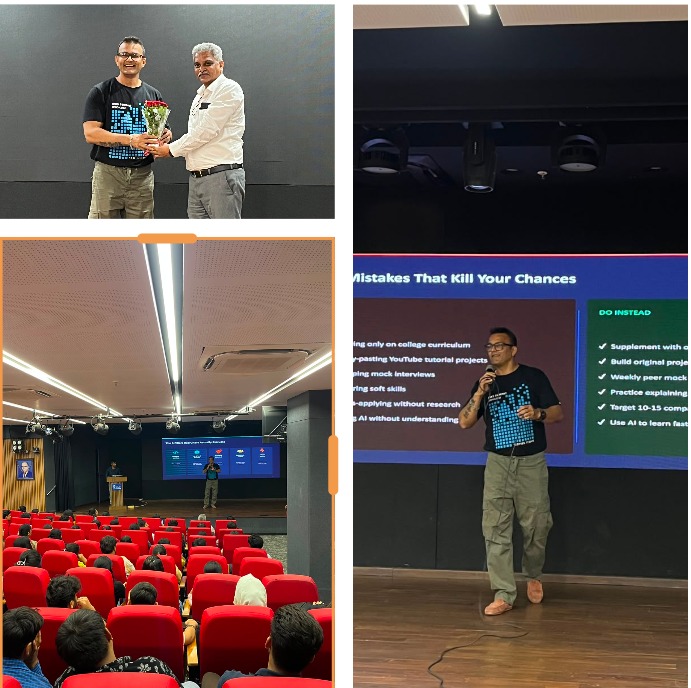
The Faculty of Computer Applications and Information Technology (PG) at GLS University organized an expert session titled -"The AI-Ready Intern: Industry Expectations and Career Readiness" on 2nd July 2026 from 3:00 PM to 4:00 PM. The session was delivered by Mr. Hardik Shah, Technical Account Manager at Amazon Web Services (AWS), with the objective of preparing students for the rapidly evolving technology landscape and helping them understand the skills required to become industry-ready AI professionals.
Artificial Intelligence has transformed the way businesses develop software, automate workflows, and solve real-world problems. Organizations across industries are increasingly adopting AI-powered solutions, making it essential for students to understand not only the fundamentals of AI but also the practical skills expected by employers. Keeping these industry demands in mind, the expert session was organized to provide students with valuable insights into AI technologies, emerging trends, and the competencies required to build successful careers in the field. The session began with an overview of the current AI landscape and the changing expectations from fresh graduates entering the technology industry.
Mr. Hardik Shah explained how AI is no longer limited to research laboratories but has become an integral part of software development, cloud computing, automation, and enterprise applications. He emphasized that modern engineers are expected to leverage AI tools effectively while maintaining strong problem-solving abilities, programming skills, and a clear understanding of software engineering principles. A significant portion of the session focused on Prompt Engineering, one of the most sought-after skills in the era of Large Language Models (LLMs).
Students were introduced to the concept of designing effective prompts that guide AI models to generate accurate and meaningful responses. The speaker discussed the importance of system prompts, few-shot prompting, and structured prompting techniques, highlighting how carefully crafted prompts can significantly improve the quality and reliability of AI-generated outputs.
The session further explored LLM API Integration, where students gained an understanding of how developers integrate AI models into real-world applications through APIs. Various AI platforms and services, including OpenAI, Amazon Bedrock, and Google Gemini, were discussed to demonstrate how organizations build intelligent applications by making API calls rather than developing AI models from scratch. The speaker highlighted how API integration enables developers to incorporate features such as conversational assistants, automated content generation, intelligent search, and document analysis into modern software systems. Another important topic covered during the session was Retrieval-Augmented Generation (RAG), which was introduced as one of the most widely adopted AI architectures in enterprise environments. Students learned about the RAG pipeline, where a user's query is first processed through a retrieval system or vector database to fetch relevant information.
This retrieved context is then combined with the user's prompt before being passed to the Large Language Model, resulting in more accurate, context-aware, and reliable responses. The speaker explained that this approach significantly reduces hallucinations and allows organizations to build AI systems capable of answering questions using their own proprietary knowledge bases. Throughout the session, practical examples and industry use cases were presented to demonstrate how AI technologies are transforming software development, cloud computing, customer support, knowledge management, and enterprise automation. Students actively participated in the interactive discussion, gaining a better understanding of current industry practices and the technical skills that employers expect from future interns and software engineers.