About M.Sc. (IT)
The M.Sc. (Information Technology) is a full-time, two-year postgraduate program designed for individuals
aspiring to build a strong foundation in modern computing. The program provides a comprehensive
understanding of IT technologies with a balanced emphasis on core computer science theories and their
practical application to solve real-world problems.
Developed with valuable input from industry professionals, the curriculum is regularly updated to reflect current technologies and employment trends. It covers a broad range of contemporary topics and is structured to support students in pursuing career opportunities or advanced research in computing and IT-related domains.
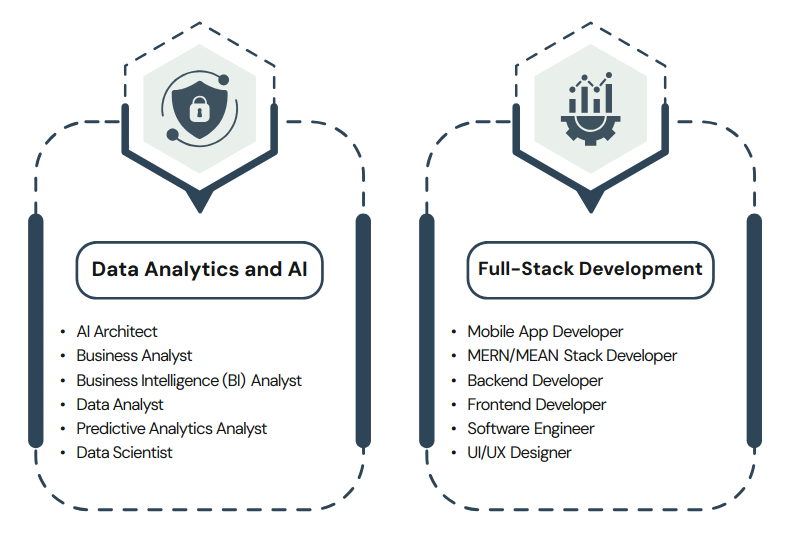
The program offers specialization tracks in Data Analytics & AI and Full Stack Development, catering to the evolving needs of the IT industry. On successful completion, graduates acquire advanced technical skills and professional competencies required to excel in IT-related careers.
Developed with valuable input from industry professionals, the curriculum is regularly updated to reflect current technologies and employment trends. It covers a broad range of contemporary topics and is structured to support students in pursuing career opportunities or advanced research in computing and IT-related domains.
The program offers specialization tracks in Data Analytics & AI and Full Stack Development, catering to the evolving needs of the IT industry. On successful completion, graduates acquire advanced technical skills and professional competencies required to excel in IT-related careers.
Programme Objectives
The M.Sc. (IT) programme focuses on the following objectives:
- Demonstrate knowledge to apply of mathematics and science in the field of Information Technology.
- Demonstrate an ability to identify, formulate and solve problems of Information Technology using relevant knowledge.
- Demonstrate an ability to design an application software, graphical user interface and other relevant software components as per given requirements and specifications.
- Demonstrate an ability to analyse, formulate and improve solutions to any real time problem in the field of Information Technology and Computer Science.
- Demonstrate skills to use latest software and hardware technologies as per the recent trends in the IT and software industry.
- Be able to assess societal, health, safety, legal and cultural issues in context of professional practice in Computer Science & Information Technology.
- Show the understanding of the impact of software engineering solutions in a global, economic, environmental and societal context.
- Demonstrate knowledge of professional responsibilities and commit to professional ethics.
- Demonstrate ability to work both as individual, team player or group leader in achieving a common goal.
- Be able to communicate effectively verbally as well as in writing with wide range of audiences.
- Be able to apply principles of software engineering and management to manage projects in multidisciplinary environments.
- Acquire knowledge and capacity for self-education to adapt to the new and upcoming IT technologies, enabling to become a life-long learner.
Career Prospects
Admission Process
- Admissions will be given based on score obtained in graduation and personal interview.
- Candidates who have appeared in the final year examination can also apply.
- GLS University reserves the right to make any exception in the above rules without any notice. However, in case of any doubt regarding interpretation of any clause, the decision of the University authorities shall be final.
- Allocation for SC, ST, SEBC etc. categories will be as per the rules of the University and State Government of Gujarat prevailing at the time of admissions.
Eligibility Criteria
The candidate should have passed any of the qualifying examination as mentioned during the current year:
- Bachelor's Degree in Computer Science | Computer Applications | Information Technology
- Bachelor's Degree in Engineering or Technology
- Bachelor's Degree in Science | Commerce | Business Administration
- Any Bachelor's Degree + PGDCA from UGC recognized University
Pedagogy
A variety of methods, including lectures, presentations, webinars, hands-on sessions, workshops,
MOOCs, interactive discussions, study tours, and industry projects, are utilized to strengthen students'
conceptual understanding, analytical skills, knowledge acquisition, and decision-making abilities,
preparing them to meet the challenges of the professional world. The pedagogy also incorporates case
studies, group collaborations, peer learning, flipped classrooms, and real-time simulations to promote
active engagement and critical thinking. Instruction takes place in well-maintained classrooms and
computer labs that are regularly sanitized to ensure a conducive learning environment.
Live Projects
Though classroom learning is given emphasis at FCAIT-PG, M.Sc. (IT) Programme, students are required to undertake a number of practical projects in the different courses of the programme for which the information gathered from business/industry is analyzed and presented in the form of reports.
Capstone Project
Every student in the final semester of the programme is required to undertake a live full time project assignment in the industry. A student chooses a topic on which primary data is gathered and analyzed in order to prepare a working system, for which he/she is supposed to work in the industry for 6 months. At the end of the duration a project report for the same is prepared that is evaluated by a panel of experts.
Curriculum w.e.f. - June 2025
| Semester I | Semester II |
|
|
| Semester III | Semester IV |
|
|